Pancakeswap connects token swaps with liquidity pools across multiple blockchains
Pancakeswap lets you exchange crypto tokens through liquidity pools across multiple blockchains, with trades authorized through a connected wallet. It is a decentralized exchange with several pool designs and additional trading tools. Liquidity providers supply assets used in swaps and earn a share of trading fees. The wider platform includes farming, staking pools, CAKE governance, token-launch events and perpetual markets. Available products, costs and token compatibility vary by network and selected feature.
Trade size and available liquidity
A swap quote reflects the selected tokens, trade size and liquidity available along eligible routes. A larger order can consume a greater share of liquidity and worsen the average execution price. The Smart Router can divide an order across routes or use intermediate pools. Disabling those options changes the routes it can consider. A lower-fee pool can still produce less output when its liquidity is shallow. The quoted output therefore reflects both the pool's fee and the trade's effect on its price.
Pancakeswap X adds an alternative path on supported networks and pairs. It draws on third-party liquidity through orders liquidity providers fill. Its use depends on support for the selected trade and a competitive quote. Tokenized stocks, bonds and exchange-traded funds from issuers including Ondo Finance extend the swap product's asset range. Regional restrictions and issuer eligibility rules apply.
How do pool designs change a swap?
Pool designs control where liquidity is available and how trading changes the exchange rate between tokens. Automated market makers, or AMMs, calculate prices using each pool's rules. Exchange v2 spreads liquidity across the full price curve. Exchange v3 lets providers concentrate assets within chosen price ranges. That can create greater depth around active prices, with less useful liquidity outside those ranges. A swap can encounter different liquidity conditions as it crosses prices.
Infinity extends the architecture with concentrated-liquidity pools, called CLAMM, and liquidity-book pools, called LBAMM. CLAMM uses price ranges; LBAMM organizes liquidity into discrete price bins. Trades within a bin use its set price until available liquidity is exhausted. Moving into another bin changes the applicable price. Pool managers implement these pricing models, while optional hooks customize behavior such as fee calculation.
StableSwap pools use a curve designed for assets expected to trade near the same price. Infinity StableSwap can adjust fees according to pool balance. A broken peg still changes the economic value of a position.
Trading fees, gas and slippage
Trading fees apply to the pools used by a swap route, so a multihop trade can involve more than one pool fee. On BNB Chain and Ethereum, Exchange v3 pool fees are 0.01%, 0.05%, 0.25% or 1% of the swap input. Exchange v2 uses a 0.25% swap fee. Infinity pools can have static fees or dynamic fees controlled by hooks. StableSwap fees follow the selected pool's configuration.
Network gas pays for blockchain execution and varies with transaction complexity and network conditions. It is separate from the pool fee. Fillers pay execution gas on X swaps, although an initial token approval can still require gas. Crosschain routes also introduce bridge charges. These differences make a single universal transaction-cost figure misleading.
Slippage tolerance sets the minimum acceptable output for an exact-input pool swap. It limits how much worse execution may be than the quote. Price impact measures the price change caused by the trade itself. Increasing tolerance accepts a larger possible shortfall without adding liquidity.
Wallet networks and crosschain routes
Network choice determines which assets, contracts and products a connected wallet can use. Deployments include BNB Chain, Ethereum, Base, Arbitrum, Solana and Aptos, with different feature coverage. Changing a wallet's selected network does not transfer its assets. Crosschain routes can include token swaps on the source network, destination network or both, alongside bridging. Supported tokens can also be bridged directly. Across handles supported routes between Ethereum Virtual Machine (EVM) networks; Relay handles supported routes between Solana and EVM networks. These swaps require adequate liquidity along the selected route and a supported chain combination. The destination asset and bridge charge belong to that particular quote. A balance on another chain cannot fund a local pool swap merely because its token symbol matches.
Liquidity positions and farm rewards
Liquidity providers supply the assets traders use and receive fee income under the selected pool's rules. Exchange v2 represents a provider's share with liquidity provider tokens, usually called LP tokens. Exchange v3 represents each configured position with a non-fungible token, or NFT. The position includes its token pair, fee tier and price range. Fee income varies with trading activity and the position's share of active liquidity. A narrow range concentrates capital and increases the need to manage exposure when prices move. A v3 position outside its range stops earning trading fees.
Yield farms add token incentives such as CAKE to eligible liquidity positions. EVM v3 farms reward staked, in-range position NFTs; v2 farms use LP tokens. Eligible Solana v3 and Infinity positions accrue farming rewards while in range, without separate staking. Farming rewards and trading fees come from different mechanisms. The displayed farm annual percentage rate, or APR, is an estimate based on changing conditions. It does not fix the value of the deposited assets or future rewards.
Relative token-price changes can create impermanent loss compared with holding the same assets separately. Fees and incentives can offset that difference, but they do not ensure a profitable position.
CAKE, staking and ecosystem products
CAKE is the platform's token for governance and several incentive or participation functions. Syrup Pools use a single staking token, commonly CAKE, to distribute the reward token specified for each pool. They do not require the paired liquidity position used in a farm. Some pools accept a different staking token, so deposit eligibility belongs to the individual pool.
Governance uses CAKE held in the wallet at the proposal's snapshot block. CAKE staked in Syrup Pools does not count toward that wallet balance. The core team implements passed core proposals, while community proposals are non-binding suggestions.
The veCAKE locking system and gauge voting were retired under Tokenomics 3.0 in 2025. Associated revenue-sharing rewards also ended. Older instructions for locking CAKE to obtain those benefits describe the retired system.
CAKE.PAD evolved from Initial Farm Offerings and provides event-based access to new project tokens through CAKE commitments. Its participation model does not require prior staking or a locked veCAKE position. Event windows and contracts remain specific to each launch. Oversubscribed events apply participation fees to excess committed funds. Prediction and Lottery are separate products involving price-direction outcomes and chance-based drawings.
Limit orders and leveraged markets
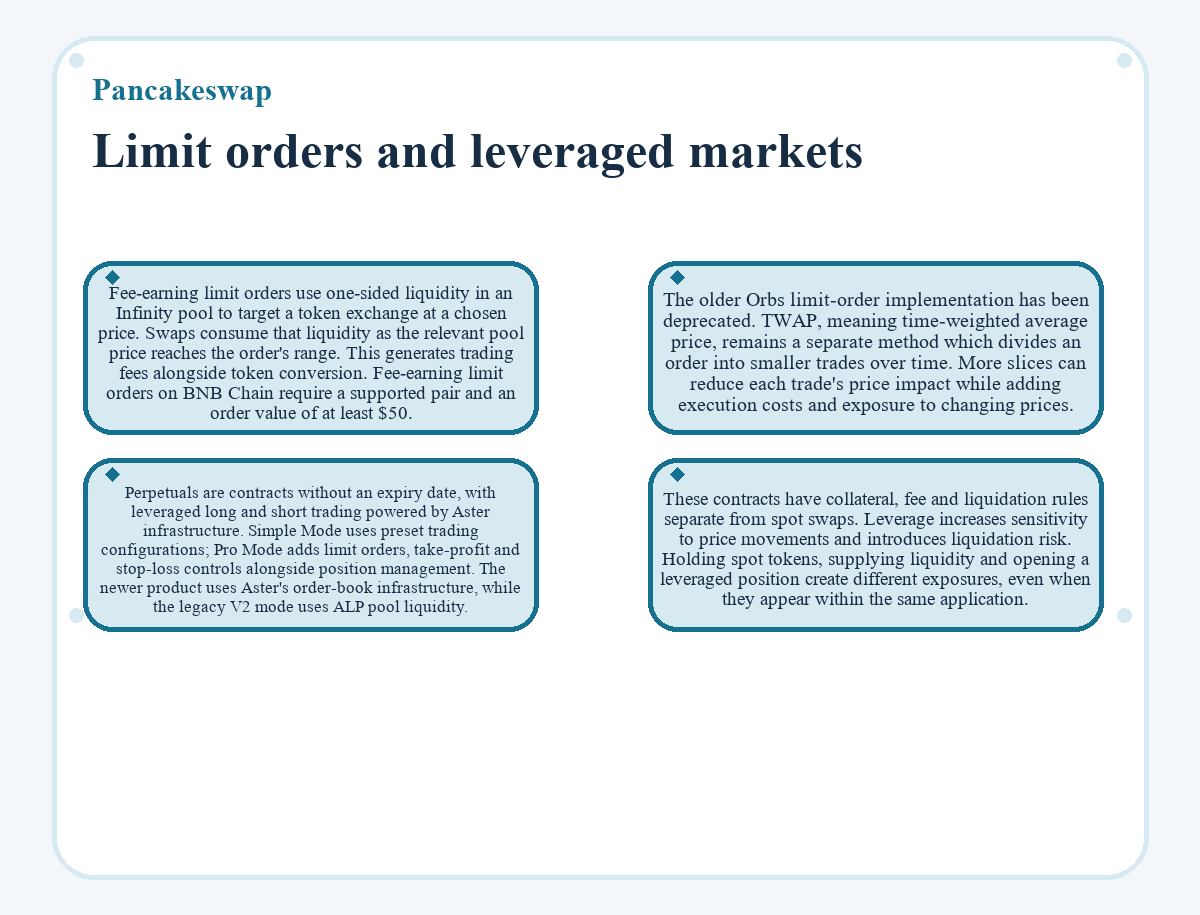
Fee-earning limit orders use one-sided liquidity in an Infinity pool to target a token exchange at a chosen price. Swaps consume that liquidity as the relevant pool price reaches the order's range. This generates trading fees alongside token conversion. Fee-earning limit orders on BNB Chain require a supported pair and an order value of at least $50. The older Orbs limit-order implementation has been deprecated. TWAP, meaning time-weighted average price, remains a separate method which divides an order into smaller trades over time. More slices can reduce each trade's price impact while adding execution costs and exposure to changing prices.
Perpetuals are contracts without an expiry date, with leveraged long and short trading powered by Aster infrastructure. Simple Mode uses preset trading configurations; Pro Mode adds limit orders, take-profit and stop-loss controls alongside position management. The newer product uses Aster's order-book infrastructure, while the legacy V2 mode uses ALP pool liquidity. These contracts have collateral, fee and liquidation rules separate from spot swaps. Leverage increases sensitivity to price movements and introduces liquidation risk. Holding spot tokens, supplying liquidity and opening a leveraged position create different exposures, even when they appear within the same application.
What should you check before committing tokens?
Token commitments should match the selected network, expected output and conditions of the trading or earning feature. A swap and a liquidity deposit commit tokens for different purposes.
- For an exact-input pool swap, compare the minimum output with the token amount you will accept.
- For a crosschain swap, check the destination asset, supported route and combined trading and bridge charges.
- For concentrated liquidity, match the price range to the exposure you can manage, including time outside the range.
- For farming, confirm the position qualifies for an active incentive program; adding liquidity alone does not establish eligibility.
- For an X order, distinguish the gas paid by fillers from any gas required for token approval.
If the required route or position is unavailable, a higher slippage tolerance does not create it.
Wallet permissions and contract exposure
Wallet permissions determine which contracts can spend approved tokens and how much they can access. Connecting a wallet, granting token approval and authorizing a trade have distinct meanings. Inspect the spender and allowance on a token-approval request. A broad token allowance can expose more tokens than the amount needed for the intended trade. Infinity hooks add pool-specific code, so protections associated with one hook do not apply to every Infinity pool. Smart contract flaws can affect funds held in trading, staking or liquidity contracts. A wallet connection or swap signature never requires disclosing the wallet's recovery phrase.
Before you start with Pancakeswap
Does Pancakeswap require CAKE for an ordinary token swap?
CAKE is not a prerequisite for an ordinary swap involving other tokens. The spending wallet needs the selected input asset and any native token required for network fees. Pool fees form part of the trade. Receiving CAKE as output also does not require holding CAKE beforehand.
Why can a successful token purchase be followed by a failed sale?
A token contract can permit purchases while restricting transfers or sales. Some contracts allow only selected addresses to sell or impose transfer charges which interfere with execution. A trading pool does not remove those token-level rules. Buying successfully therefore does not establish the ability to sell later, and increasing slippage cannot bypass a contract's transfer prohibition.
What happens when a fee-earning limit order fills only partly?
A partially filled fee-earning limit order holds both unconverted input tokens and converted output tokens. Swaps have consumed only part of its deposited liquidity. The interface distinguishes this state from a fully filled order. Cancelling permits withdrawal of both token balances plus earned trading fees; the remaining input has not become the target output.
Can an approved token still fail to swap?
Token approval does not ensure a swap will execute. Approval grants spending permission, while the swap must also satisfy its route, balance and output requirements. Insufficient network gas or a token's transfer restrictions can prevent execution. A successful approval status establishes permission for the relevant contract, not a completed exchange or receipt of output tokens.
Is trading from a connected wallet anonymous?
A wallet connection does not make onchain swaps anonymous. Standard swaps leave transaction and token-transfer records associated with wallet addresses, even when an exchange does not require account registration. An address linked to an identity elsewhere can connect that identity to its public trading history. Wallet-based access and transaction privacy describe different properties.
Are rebasing tokens compatible with Exchange v3 liquidity pools on EVM networks?
Exchange v3 on EVM networks does not support rebasing tokens or fee-on-transfer tokens. Depositing such tokens can leave assets stuck in the liquidity position. This restriction concerns that pool version's liquidity provisioning. A token's availability through another trading route does not establish compatibility with a v3 deposit, and a quoted swap should not be treated as approval for creating that position.
Updated: