Pancakeswap directs part of swap fees to CAKE burns
Pancakeswap directs a portion of eligible swap fees toward CAKE buybacks and burns. Liquidity providers and the treasury receive other allocations, with different rules across pool designs and networks. A pool's trading fee is the charge on the swap; its burn share is the portion reserved for removing CAKE from circulation. Those percentages use different calculation bases.
Exchange V2, Exchange V3 and Infinity have different fee structures and allocation rules. Understanding their contributions explains where trading revenue goes, how pool rewards differ from farm incentives and why a burn figure differs from net supply reduction.
Pool rewards and protocol revenue
Swap fees connect the liquidity used for trading with rewards for its providers and revenue for the protocol. Liquidity providers (LPs) supply assets to an automated market maker (AMM), which prices exchanges through its pool rules. Their fee allocation compensates them for making those assets available. A provider's income follows the LP allocation and their share of participating liquidity.
Protocol revenue can support operations or fund CAKE removal, depending on its assigned destination. An LP owns a claim on the provider allocation through a liquidity position. Holding CAKE alone does not create that claim.
V2 allocations from the swap amount
Exchange V2 charges a 0.25% trading fee on each pool swap, with its components expressed against the same input amount. The LP allocation is 0.17% of that input, while the treasury allocation is 0.0225%. Exchange V2 allocates 0.0575% of the swap input toward CAKE buyback and burn.
Expressed as shares of the collected trading fee, the allocation is 68% for LPs, 9% for the treasury and 23% for buyback and burn. The 23% figure uses the collected fee as its denominator. It therefore answers a different question from the input-based 0.0575% rate.
V2 provider fees remain within pool reserves and contribute to the assets represented by LP tokens. Each provider's entitlement follows their pool share. This reserve-based treatment differs from the separately claimable trading fees in a standard Exchange V3 position.
V3 fee tiers and network-specific splits
Exchange V3 on Ethereum Virtual Machine (EVM) networks has 0.01%, 0.05%, 0.25% and 1% fee tiers, with allocations stated as shares of the collected fee. At the 0.01% tier, LPs receive 67%, burn funding receives 15% and the treasury receives 18%. At 0.05%, those shares are 66%, 15% and 19%. Both the 0.25% and 1% tiers allocate 68% to LPs, 23% to burns and 9% to the treasury. A fee tier identifies the trading charge, while these shares describe its distribution.
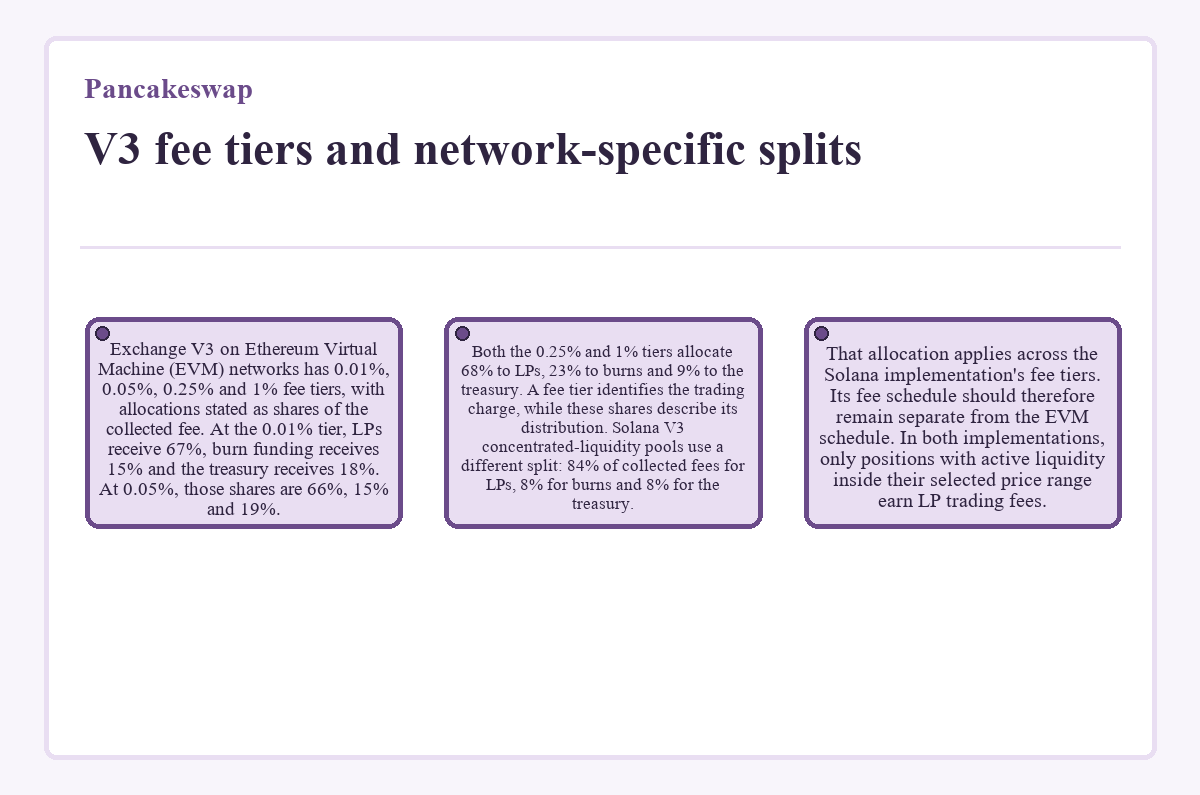
Solana V3 concentrated-liquidity pools use a different split: 84% of collected fees for LPs, 8% for burns and 8% for the treasury. That allocation applies across the Solana implementation's fee tiers. Its fee schedule should therefore remain separate from the EVM schedule. In both implementations, only positions with active liquidity inside their selected price range earn LP trading fees.
Pool designs and fee-earning conditions
Pool implementations differ in their fee settings and in the liquidity eligible to earn the provider portion. Exchange V2 and Classic StableSwap use LP-token shares. Concentrated-liquidity designs use selected price ranges, while Infinity LBAMM distributes liquidity across discrete price bins. These differences affect participation in fee income even when the traded assets are similar. Available pools also depend on the selected network.
| Pool implementation | Fee structure | Liquidity participation |
|---|---|---|
| Exchange V2 | Fixed trading fee with defined allocations | LP tokens represent a share of pooled reserves |
| Exchange V3 on EVM | Pool-specific fee tier and tier-dependent split | Only in-range liquidity earns swap fees |
| Solana V3 concentrated liquidity | Its own tiers and network-specific split | Only in-range liquidity earns swap fees |
| Classic StableSwap | Pair-specific fixed fee | LP-token shares determine provider rewards |
| Infinity CLAMM | Static or dynamic LP fee; configurable protocol fee | Liquidity participates within its selected price range |
| Infinity LBAMM | Static or dynamic LP fee; configurable protocol fee | Swap fees accrue where trades use the liquidity bins |
| Infinity StableSwap | Dynamic fee sensitive to pool balance | Full-curve liquidity does not require selected price ranges |
Infinity LP fees and protocol settings
Infinity separates LP fee settings from protocol fee settings, allowing pool-specific behavior beyond the Exchange V3 tier schedule. CLAMM uses concentrated liquidity, while LBAMM uses price bins. Either design can have a static LP fee or a dynamic fee controlled through an attached hook. A static fee remains fixed after initialization; the choice between static and dynamic fee types also remains fixed.
The protocol fee controller sets the protocol component and can update it for an existing pool. Infinity core caps each directional protocol fee at 0.4% of the input amount. That cap concerns the protocol component, rather than the complete trading charge. Hook-level charges can also exist where the hook implements them, with their own recipients and conditions.
Infinity pools on Robinhood Chain use a 90% LP and 10% protocol split announced in September 2026. The protocol share does not, by itself, specify how much reaches CAKE burns. Applying an EVM V3 burn percentage to that entire share would mix different fee arrangements.
Classic and Infinity StableSwap fee rules
Classic StableSwap allocates 50% of its collected trading fee to LPs, 40% to CAKE buyback and burn and 10% to the treasury. Its actual trading rate belongs to the individual pair's configuration. A larger burn share of the fee can coexist with a lower trading charge, because allocation percentages and swap fee rates measure different things. StableSwap targets assets expected to trade near the same price.
Infinity StableSwap changes the fee behavior through a hook, allowing effective fees to respond to pool balance. Trades restoring equilibrium may face lower effective fees; trades worsening imbalance may face higher fees. Its liquidity spans the full curve without a selected price range. The Classic StableSwap allocation does not automatically transfer to this separate implementation. Balance-sensitive fees also cannot restore the external value of an asset whose peg has broken.
Treasury holdings and burn funding
A treasury policy implemented on March 2, 2026 keeps treasury-bound protocol fees from eligible stablecoin pools in stablecoins, while fees from non-stablecoin pools continue to be converted into CAKE. The policy initially covered stablecoin pools containing at least one of USDT, USDC, USD1 or U. The policy concerns the form of assets retained by the treasury. A CAKE balance held for treasury purposes remains distinct from CAKE assigned to burning. Treasury resources can fund audits, development and incentives, while burn funding pays for token removal. Converting an allocation into CAKE therefore does not establish its final destination.
Buybacks, burns and fee-token units
CAKE buybacks convert allocated protocol revenue into CAKE, and burning then removes those tokens from spendable circulation. Fees collected in another asset provide funding for that acquisition. The fee amount and the quantity of CAKE ultimately burned use different units, so they cannot be equated without the conversion terms.
The buyback price affects how much CAKE a revenue allocation can acquire. Holding the funding budget constant, a higher acquisition price buys fewer tokens. Fee allocation records describe funding; completed burns describe CAKE removed. CAKE sent to the burn address is permanently removed from circulation.
A token explorer's total-supply counter can still include CAKE held at the burn address. Supply calculations excluding irretrievable tokens therefore differ from that raw contract figure.
Liquidity fees beside CAKE farming rewards
CAKE farming rewards and LP trading fees come from different mechanisms, even when both appear in one yield display. Trading fees accrue from swaps using a pool's liquidity. Eligible farm positions can additionally receive CAKE through the farm's reward allocation. Farm reward rates reflect emissions and allocation settings; LP fee income reflects trading activity and the position's participating liquidity. Earning either component does not mean the provider receives the treasury or burn allocation. The currencies earned through trading fees belong to the pool's traded assets.
An annualized fee estimate projects income from a measured period, while a farm estimate values its reward stream. Neither figure fixes future revenue. Unclaimed V3 fees also sit outside active liquidity, even when they appear in the pool's token balances. Impermanent loss can outweigh fee income, so earned fees alone do not describe the position's overall performance.
How does routing affect the CAKE burn contribution?
Each pool used by an eligible AMM route applies its own fee and allocation, making the route's pool mix part of the burn-funding calculation. A multihop route charges fees at its individual pools, using each hop's input amount. Those inputs can involve different tokens and amounts. Split routing distributes the trade across paths, so a pool's allocation applies only to the volume it processes. The swap's Fee and Route details identify the charge and the pools behind it. Aggregating revenue across different input tokens requires a consistent valuation basis. Adding their raw token quantities cannot establish a meaningful total burn budget.
Gross burns and net supply changes
September 2026 recorded 2,963,567 CAKE burned and 652,564 CAKE minted, leaving a net supply reduction of 2,311,003 CAKE for the reported month. Gross burns count tokens removed, while new emissions add tokens during the same accounting period. Net supply reduction measures the difference between those flows. The September burn total combined core AMM activity with side products, so it was broader than spot swap fees alone. Farm and ecosystem emissions also contributed to the mint side of the accounting.
The September report excludes mints that directly contribute to burning and prorates weekly burns across reporting periods. A monthly total can therefore differ from simply summing burn transactions dated within that calendar month. Its reporting basis limits comparisons with another period.
Questions and answers
Does a larger CAKE burn guarantee a higher token price?
A larger CAKE burn does not guarantee a higher market price. Burns remove tokens from circulation, while price also reflects demand, trading liquidity and selling pressure.
Are V3 trading fees automatically reinvested in a liquidity position?
Fees in a standard Exchange V3 position do not compound automatically. They accrue separately from the position's active liquidity and are available for manual collection. Collecting fees does not itself add the assets back into the position. Reinvestment requires contributing them as liquidity, which is a different operation from claiming the earned fees.
When does an out-of-range V3 position resume earning trading fees?
An Exchange V3 position resumes earning swap fees when the pool price returns inside its selected range. An unchanged position can become active again without resetting that range. It earns from swaps using its liquidity while active; it does not accrue missed trading fees retrospectively for the interval spent outside the range.
Is blockchain gas included in the CAKE buyback allocation?
Blockchain gas falls outside the pool fee split used for CAKE buybacks. The network cost follows the selected blockchain's execution-fee rules. A pool's quoted trading fee and a wallet's network-fee estimate therefore describe separate charges. Applying the pool's burn percentage to the gas estimate would assign network costs to the wrong mechanism.
Why can a token transfer tax appear alongside a pool fee?
A transfer tax comes from the token contract, separate from the liquidity pool's trading fee. It can change the amount transferred or received, and any token-level burning follows that token's own rules. Standard EVM Exchange V3, Infinity CLAMM and Infinity LBAMM pools do not support fee-on-transfer tokens. Custom routers or token wrappers have separate compatibility requirements.
Can holding CAKE reduce every Infinity pool's trading fee?
A CAKE-based Infinity fee discount requires a hook implementing that benefit for the selected pool. Hooks can use token holdings in their fee logic, with eligibility conditions defined by the implementation. Holding CAKE alone does not establish a universal discount. A hook's recipient rules also determine where any custom fee or rebate goes.
What happens to an Infinity protocol fee when the swap direction reverses?
Infinity charges its directional protocol fee in the input token for that swap. Reversing direction changes which token supplies the calculation base. The protocol configuration can hold separate fee rates for the two directions. The reverse trade therefore uses its own input amount and applicable directional setting, even within the same pool.
Does burning CAKE change its maximum supply cap?
Burning CAKE does not automatically change the governance-set supply cap. A cap-reduction proposal introduced on January 16, 2026 established a 400,000,000 CAKE ceiling after passing governance. That ceiling differs from the amount remaining in circulation. A cap adjustment requires its own governance change; a burn removes tokens within the existing supply framework.
Updated: